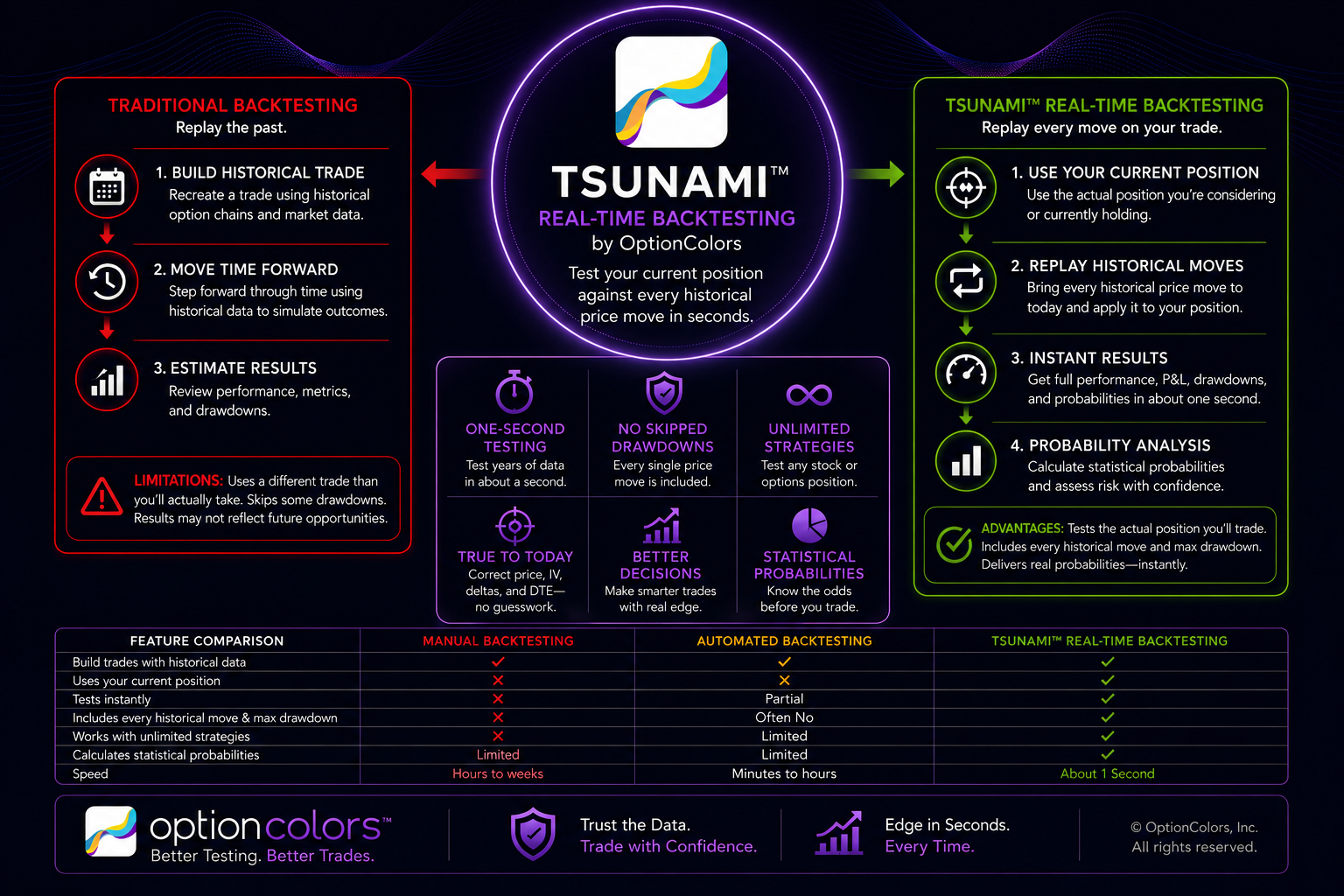
Options backtesting has evolved from manually replaying historical option chains to automated systems capable of evaluating years of data. These tools can provide useful context, but most traditional methods share the same basic limitation: they test historical positions rather than the position a trader owns or is considering today.
OptionColors developed Tsunami™, a patent-pending backtesting technology designed to reverse that process. Instead of rebuilding a different trade in the past, Tsunami applies historical market movements to the trader's current stock and options position.
The Evolution of Options Backtesting
Exchange-traded options began in 1973, and traders have explored ways to study historical performance ever since. Early options software made it possible to move an option chain back to a prior date, construct a trade and then advance the market one day at a time.
OptionVue, founded by options-software pioneer Len Yates in 1983, became one of the best-known early platforms to offer this type of manual historical analysis. A trader could select an earlier date, build a position and move forward through subsequent market data to observe how the trade might have behaved.
The process represented a major improvement over paper calculations, but it was labor-intensive. Testing only a modest number of positions could require many hours or weeks of repetitive work.
Automated Backtesting
As retail charting, market data and software-development tools became more accessible, automated options backtesters began to appear more widely. These systems allowed traders to define entry, exit and adjustment rules and then evaluate many historical trades much faster than a manual replay.
Automation greatly expanded the amount of data a trader could analyze. Manual and automated backtesters differ in speed and flexibility, but most follow the same underlying model: construct a position at a historical date and move that historical trade forward through historical data.
The Historical-Trade Problem
A historical trade is not necessarily the same trade a trader will encounter in the future. The underlying price, implied volatility, available strikes, expiration cycle, interest rates, market participants, liquidity, company fundamentals and event environment may all be different.
Consider a five-year iron-condor backtest. The trader may define a consistent entry at 30 days to expiration, select target deltas and apply fixed adjustment rules. The result shows how those historical iron condors performed under the specified assumptions.
That information can be useful, but the trader may never encounter those exact combinations of price, volatility, strike availability and market conditions again. The test therefore evaluates a historical strategy sample—not the precise position the trader owns today.
Curve Fitting and Missing Drawdowns
Another risk is curve fitting, sometimes called overfitting. This occurs when rules are repeatedly adjusted until they perform unusually well on a specific historical sample.
Traders do not need to manipulate a test intentionally for this to happen. It can emerge naturally as entry dates, deltas, exits and adjustment rules are refined using the same historical period.
Manual testing makes it difficult to evaluate enough observations efficiently. Automated testing improves speed, but results can still depend heavily on sampling frequency and available data. A test that checks only selected dates or intervals may fail to capture a major drawdown.
Traditional vs. Tsunami™ Backtesting
| Capability | Manual | Automated | Tsunami™ |
|---|---|---|---|
| Primary test subject | Historical trade | Historical trade series | Current position |
| Typical workflow | Replay dates manually | Run predefined rules | Apply historical moves instantly |
| Testing speed | Slow | Faster | Designed for one-click results |
| Strategy flexibility | Broad, but labor-intensive | Limited by supported rules | Tests stocks and option combinations |
| Uses today's position inputs | No | No | Yes |
| Historical-move coverage | Depends on manual sampling | Depends on data and intervals | Designed to include every tested move |
| Statistical probabilities | Limited | Varies by platform | Integrated into the analysis |
A Different Backtesting Question
Traditional backtesting asks:
How did similar strategy rules perform on trades created in the past?
Tsunami is designed to ask a different question:
How would my current position respond if it experienced historical market movements?
This distinction matters because the current position retains its actual structure, including its underlying price, strikes, expirations, quantities, directional exposure and volatility characteristics at the time of the test.
Real-Time Backtesting with Tsunami™
Tsunami brings historical market movements forward to the current position rather than sending the position backward to a different historical market.
The trader can construct or load a stock and options position and initiate the test with a single action. Tsunami then evaluates how that position would respond across the historical movement set used by the system.
OptionColors describes this as real-time backtesting because the subject of the test is the trader's actual present-day position—not a reconstructed historical position with different strikes, prices, volatility and risk measurements.
Testing in Seconds
Traditional manual testing can require hours to evaluate a small number of examples. Automated testing can process much larger samples, but it may still require strategy definitions, rule configuration and batch processing.
Tsunami is designed to complete multi-year testing in approximately one second under typical conditions. This allows traders to compare positions, strikes, expirations and adjustments without creating a separate historical study for every variation.
Designed Not to Skip Major Drawdowns
A backtest can present an incomplete risk picture when the sampling method skips a large adverse movement. Tsunami is designed to include every price movement in its tested historical sequence rather than checking only selected entry dates or periodic snapshots.
Including the full movement set can reveal losses or drawdowns that might be missed by a more limited sampling process. This does not predict the next drawdown, but it can provide a broader view of how the current position responds to adverse historical conditions.
Test Stocks and Option Combinations
Rule-based automated backtesters generally support a defined collection of strategies and adjustment logic. That structure is useful for large systematic tests, but it may restrict positions that fall outside the available templates.
Tsunami is designed to evaluate custom combinations of stocks and options. A trader can construct a conventional spread, a multi-leg position, a hedged portfolio or a structure that does not fit a standard strategy name and then test the combined position.
Probability Beyond Traditional POP
Many options platforms display probability of profit using a theoretical distribution and a fixed expiration outcome. That measurement can be informative, but it represents a model-based estimate rather than an examination of how the actual position responds across historical movements.
Tsunami supplements conventional probability measurements with statistical analysis derived from its historical movement tests. The objective is to provide another perspective on the range of outcomes and risk contained in the current position.
Backtesting Is a Decision Tool, Not a Promise
No backtesting method can reproduce future market conditions or guarantee a profitable result. Historical movements may not repeat, execution can differ from model assumptions and volatility relationships can change in ways that are not represented by prior data.
The purpose of backtesting is to improve understanding. Traders can use it to compare alternatives, identify hidden risk, evaluate potential drawdowns and test whether a position behaves consistently with the intended thesis.
Tsunami does not eliminate the limitations of historical analysis. It changes the subject of the test from a reconstructed historical trade to the position the trader is evaluating now.
A New Stage in Options Backtesting
Manual backtesting made it possible to replay historical trades. Automated backtesting made it possible to test larger rule-based samples. Tsunami introduces a patent-pending approach designed to evaluate the trader's current position against historical market movements in seconds.
Each method can serve a different purpose. Traditional testing remains useful for studying systematic rules and historical strategy behavior. Real-time position testing adds another layer by helping traders examine the exact structure they are considering today.
The result is a more direct connection between historical analysis and the decision currently in front of the trader.